Art collecting does not always begin with a planned gallery visit, a carefully considered budget or an extensive understanding of art history.
Sometimes it begins much more quietly.
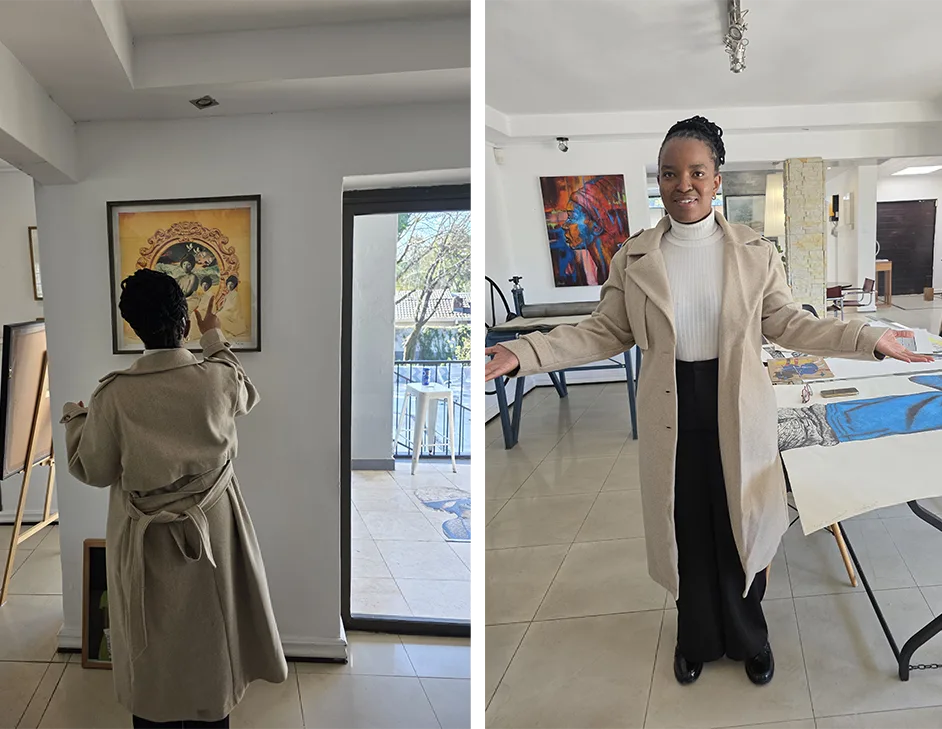
I worked with Dimpho when she was a copywriter, and one day we found ourselves walking through the studio together. I was showing her some of the work, talking about my own relationship with art and sharing more about what we were building through Perspective Art.
There was no collector consultation and certainly no intention to turn the afternoon into one. We were simply looking, talking and discovering that art was something we both cared about.
Dimpho already had a creative relationship with it. She made art herself, followed artists and enjoyed looking at work. But, as is often the case, there can be a strange distance between loving art and thinking of yourself as someone who can actually collect it.
Somewhere during that visit, that distance became a little smaller.
When recognition happens before explanation
Among the works Dimpho encountered was Tawanda Muafrika’s Thi Wuman with Her Muunlait.
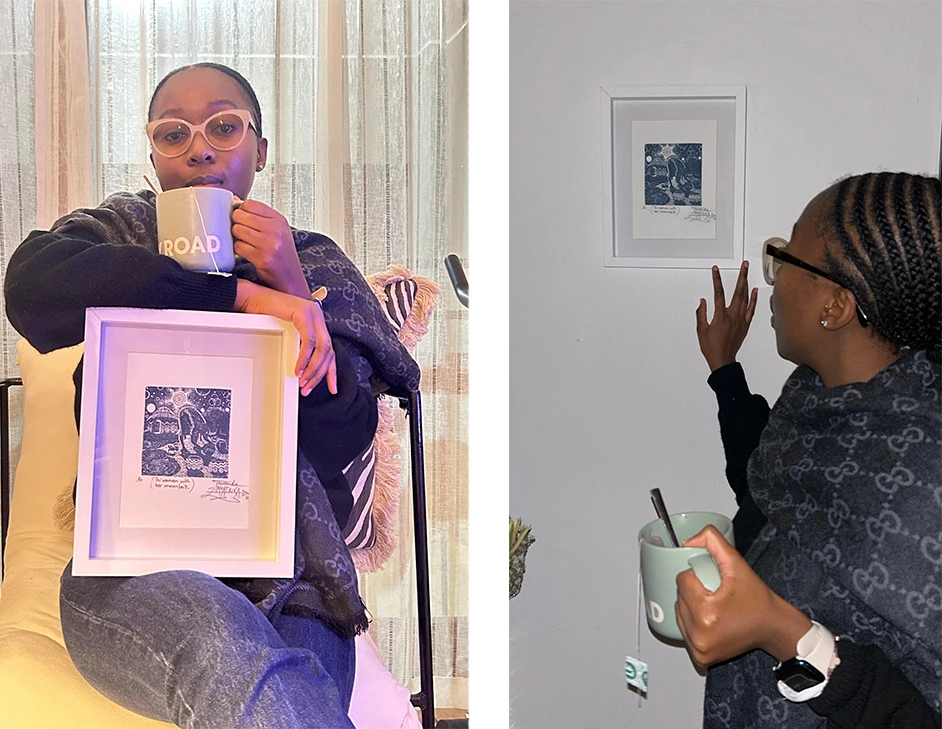
The signed, editioned print presents a woman beneath a night sky, surrounded by vessels, water, circular forms and suggestions of rural life. It is intimate in scale, but there is a whole world contained within it — the kind of image that seems to hold memories even before you know whose memories they are.
For Dimpho, something in that world was immediately familiar.
It reminded her of the stories her mother had told her about where she came from and how she had grown up. What she recognised was not necessarily a literal reconstruction of those stories. It was something more instinctive: an atmosphere, a way of living, traces of a place she knew through somebody she loved.
As she explains:
“I always gravitate towards art that somehow tells my story — my story through people I love, or even the things I love. For this particular piece, it told my mom’s story. It reflected how she describes where and how she grew up. When I saw Thi Wuman with Her Muunlait, I saw those tales. I just had to get it. It perfectly captures that.”
There is something beautiful about that kind of recognition.
An artwork does not always have to tell your story literally in order to belong to it. Sometimes it simply touches something already present in you.
Dimpho brought her mother’s stories to the work, and the work gave those stories another place to live.
We often collect through other people
We speak about personal taste as though it is entirely individual: What do I like? What colours am I drawn to? Which artists speak to me?
But our responses to art are rarely formed in isolation.
We carry people with us when we look.
A landscape might remind us of where our grandparents lived. A certain kind of light may return us to a childhood home. The posture of a figure, a fabric pattern, a cooking vessel or the shape of a homestead can summon something we had not consciously been searching for.
Sometimes the memory is our own. Sometimes it has been inherited through stories.
In Dimpho’s case, the artwork became a meeting point between her mother’s lived experience and her own act of remembering it.
She was buying a work by Tawanda Muafrika, with its own artistic intention, history and place within his practice. At the same time, she was giving the work a new personal life — one in which her mother’s story could sit beside the artist’s.
That, for me, is one of the most compelling things about collecting.
The artist creates the work, but meaning does not end in the studio. It continues wherever the work goes.
You do not need permission to respond
In our first Collecting 101 guide, we explored an idea that remains central to how we think about collecting at Perspective Art: you do not need formal art training to begin.
Dimpho’s experience is a good example of what that means in practice.
She did not need to construct an academic interpretation of the image before she was allowed to connect with it. She did not have to identify every reference, defend her reading of the work or prove that her response was the “correct” one.
She saw something that felt true to her own life.
That was where the relationship began.
Of course, learning more about an artist can deepen that relationship. Understanding a medium, a technique or the context surrounding a work often opens new ways of seeing it. But knowledge does not always have to precede feeling.
Sometimes curiosity comes afterwards.
You encounter something first. It stays with you. And because it stays with you, you want to know more.
A first work does not have to be a grand gesture
There is also something important about the fact that Dimpho began with a print.
Printmaking can offer an approachable way into collecting because editioned works often exist at more accessible scales and price points while retaining the authorship, process and intention of the artist.
A signed and numbered print is not simply an image reproduced for decoration. It belongs to a defined edition and emerges from an artistic process in its own right.
But what I particularly like about prints is their intimacy.
They often ask you to move closer.
Thi Wuman with Her Muunlait does not need to command an entire room to make itself felt. Its details reward proximity, while the story Dimpho sees within it extends far beyond the physical dimensions of the paper.
There is a useful reminder in that.
Your first acquisition does not need to announce the beginning of a collection.
It only needs to mean enough for you to want to live with it.
From the studio into her home
There is always a small shift that happens when an artwork leaves us.
In the studio, we know it as part of an artist’s wider body of work. On the website, it exists among other artworks, photographs and descriptions, still waiting for the person who will eventually choose it.
Then it enters somebody’s home.
The context changes completely.
Dimpho later sent photographs of the framed work. In one, she sits with it resting against her. In another, it hangs on the wall, surrounded by the textures, furniture and light of everyday life.
And suddenly the work feels settled.
It no longer looks like something waiting to be acquired.
It belongs.
I think that transformation is particularly moving when you know why the collector chose the work. What hangs on Dimpho’s wall is still Tawanda’s artwork, but it has also become a point of return for her — something through which her mother’s memories remain present in a visual and tangible way.
Perhaps this is why the artworks we live with can become so different from the artworks we merely admire.
Time begins to gather around them.
We pass them in the morning. Guests notice them. Children grow up seeing them. We move houses and decide which wall they belong on next.
Eventually, they become part of the architecture of memory itself.
A collection can begin with one honest choice
There is sometimes pressure around the idea of becoming a collector.
It can sound like something that requires strategy from the beginning: the right artists, the right acquisitions, perhaps even the right language for speaking about them.
But almost every meaningful collection has to begin somewhere.
Often, that beginning is simply one work that makes you stop.
One work that reminds you of someone.
One work you continue thinking about after you have walked away from it.
Dimpho’s acquisition reminds me that collecting, at its most personal, is not really about accumulating objects. It is about deciding which ideas, histories and feelings deserve space in the environments we call home.
And over time, those individual decisions start to reveal something.
A collection becomes a kind of autobiography assembled slowly and indirectly — through the artists we respond to, the places we remember, the people we carry with us and the questions we keep returning to.
One honest choice at a time.
Bringing people closer to art
This is the kind of relationship with art we hope to encourage through Perspective Art.
We care deeply about the work itself — the artist, the process, the provenance, the edition, the presentation. Those things matter.
But taking art seriously should never require making people feel small in front of it.
We want people to come closer.
To spend time looking. To ask the questions they think they are not supposed to ask. To visit the studio. To discover an artist they did not know before. To trust an instinct and then allow knowledge to grow around it.
The art world has sometimes surrounded collecting with unnecessary distance. Our interest is in shortening that distance while maintaining the integrity of the work.
Sometimes that journey begins through our Art Finder. Sometimes it begins while browsing available artworks.
And sometimes it begins far more casually — with two colleagues wandering through a studio and talking about art.
For Dimpho, that conversation led to Thi Wuman with Her Muunlait.
For the artwork, it led home.